Beautiful Plants For Your Interior

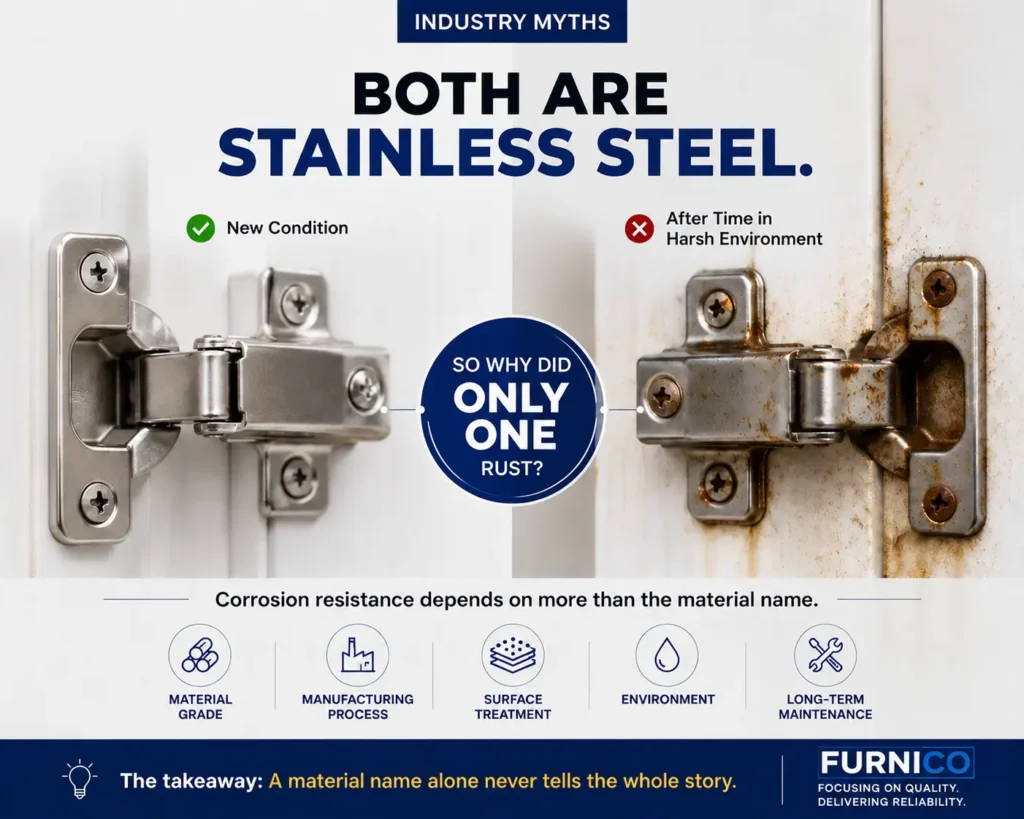
Most people assume the answer is no.
After all, it’s called stainless steel.
But in reality, even stainless steel cabinet hinges can develop corrosion under certain conditions. The material name alone doesn’t guarantee long-term performance.
Whether you’re selecting cabinet hinges for a new kitchen, replacing existing kitchen cabinet hinges, or specifying cabinet hardware for a commercial project, understanding what really affects corrosion resistance can help you make better long-term decisions.
One of the most common misconceptions in the cabinet hardware industry is that stainless steel is completely rust-proof.
It isn’t.
The word “stainless” simply means the material has a higher resistance to corrosion than ordinary steel. It does not mean corrosion is impossible.
That’s why two stainless steel hinges can perform very differently—even when they look almost identical.
The difference often lies not in the name of the material, but in how the product is engineered and manufactured.
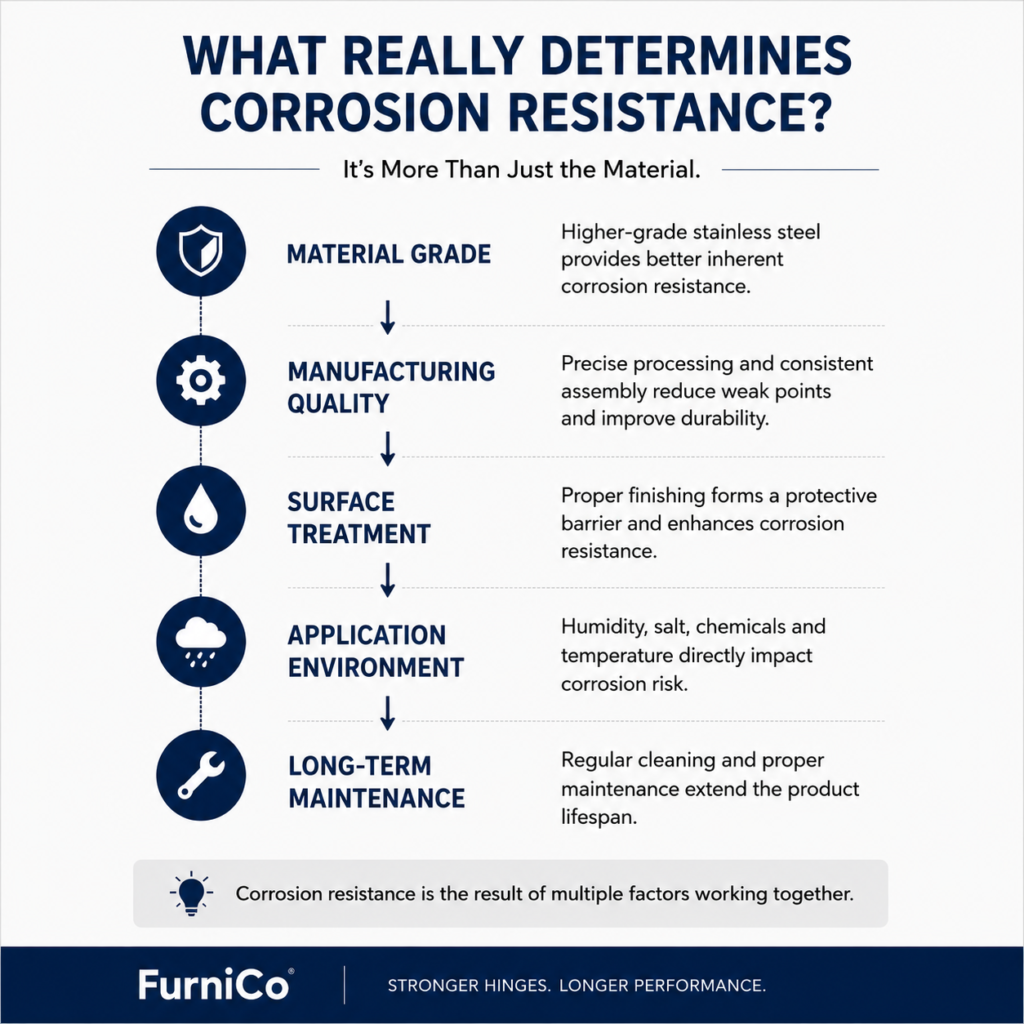
Corrosion resistance depends on far more than the material itself.
Several factors work together to determine how well a hinge performs over years of daily use.
These include:
✔ Material grade
✔ Manufacturing consistency
✔ Surface treatment and finishing
✔ Production quality control
✔ Service environment
✔ Long-term maintenance
For example, cabinet hardware installed in a coastal home is constantly exposed to salt and humidity, while hardware used in a dry indoor environment experiences far less corrosion stress.
The same hinge may perform very differently simply because it is used in a different environment.
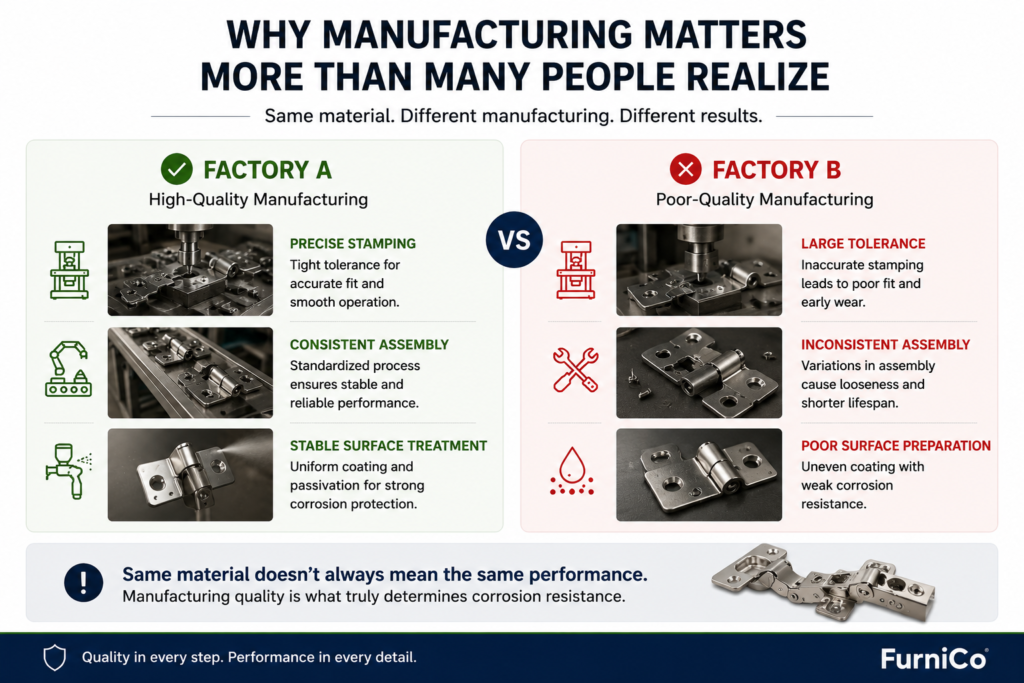
Material is only one piece of the puzzle.
For cabinet hinges, the manufacturing process often has just as much influence on long-term durability.
Even if two manufacturers claim to use the same stainless steel grade, differences in production can lead to very different results.
Factors such as:
can all influence how well a hinge resists corrosion over time.
This is one reason why two products that look almost identical may perform very differently after several years of use.
Instead of asking only:
“Is it stainless steel?”
It may be more useful to ask:
These questions often provide a much clearer picture of quality than the material name alone.
Whether you’re choosing soft close cabinet hinges, hidden cabinet hinges, or standard cabinet hinges, long-term performance depends on much more than the material alone.
However, corrosion resistance is never determined by a single factor.
Material selection, manufacturing quality, surface treatment, installation environment, and production consistency all contribute to the overall performance of a hinge.
Understanding these factors makes it easier to choose hardware that not only looks good on day one, but continues to perform reliably for years to come.
✅ Stainless steel is corrosion-resistant, not corrosion-proof.
✅ Material grade alone doesn’t determine performance.
✅ Manufacturing quality matters just as much.
✅ Choose the right hinge for the application environment.
Yes. Although stainless steel offers excellent corrosion resistance, it can still corrode under certain environmental conditions. Material grade, manufacturing quality, surface treatment, and exposure to moisture or salt all affect long-term performance.
Not necessarily. The soft-close mechanism affects how the hinge closes, while corrosion resistance depends primarily on the material, manufacturing process, and surface protection.
In most cases, yes. The two terms are often used interchangeably to describe hinges that are hidden from view when the cabinet door is closed.
Look beyond the material name. Consider the hinge type, manufacturing quality, corrosion resistance, testing standards, and whether the product is suitable for the environment where it will be used.
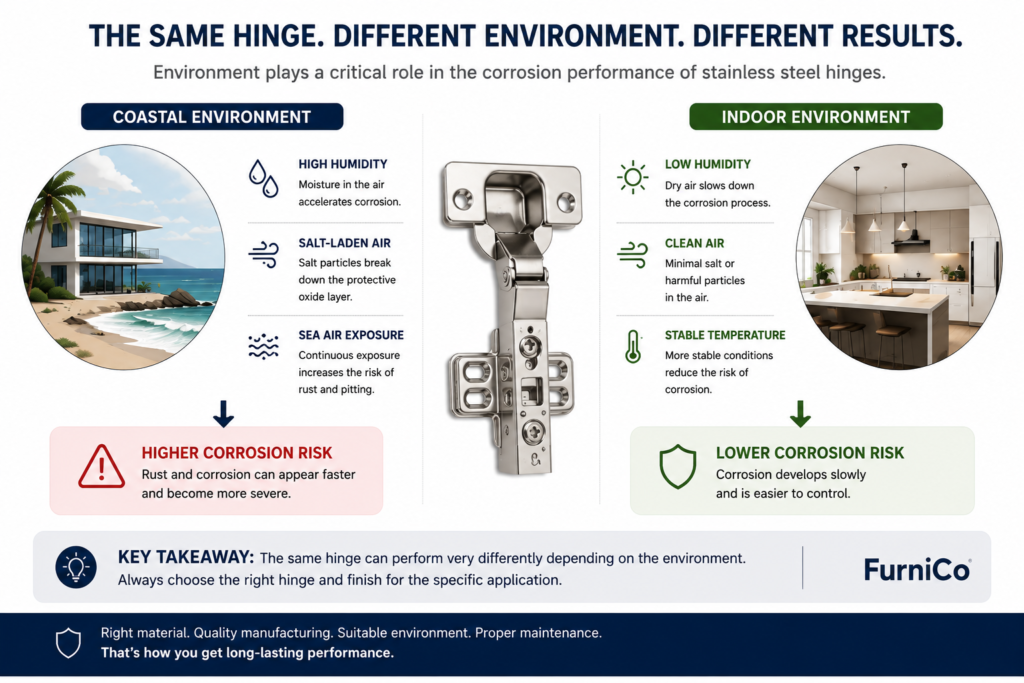
Imagine two cabinet projects.
One is installed in a dry residential kitchen.
The other is installed in a beachfront property with high humidity.
Even if both use stainless steel cabinet hinges, their long-term corrosion performance can be very different.
You may like:
Manufacturing Defect or Installation Issue? How to Identify Cabinet Hardware Problems
Learn more about stainless steel corrosion from the Stainless Steel Information Center https://en.wikipedia.org/wiki/Stainless_steel