Beautiful Plants For Your Interior
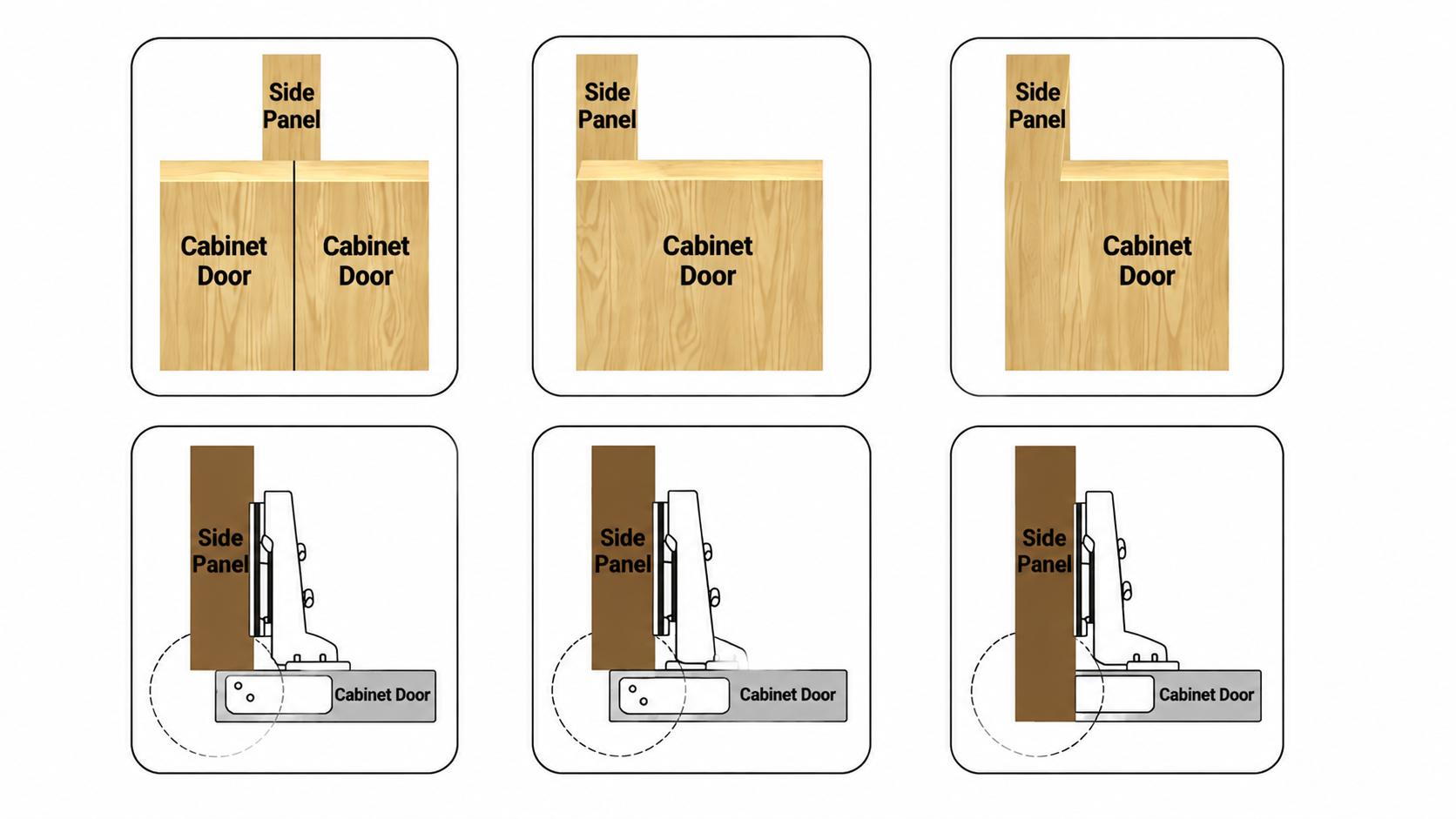
Many cabinet buyers focus on hinge features such as soft close function, opening angle, and adjustment capability. However, choosing the correct cabinet hinge overlay is one of the first steps to achieving proper door alignment and a professional cabinet appearance.
Overlay determines how the cabinet door sits in relation to the cabinet structure when the door is closed.
Choosing the wrong overlay application can result in incorrect door gaps, poor alignment, or unsuitable hinge selection.
The three most common cabinet door overlay applications include:
Note: In North‑American hardware search resources, half‑overlay is frequently referred to as partial‑overlay. Both terms describe the same shared‑partition hinge configuration for cup‑style concealed hinges.
Understanding these applications helps cabinet manufacturers, distributors, and installers select the correct hinge solution for different cabinet projects.

Cabinet hinge overlay refers to how much a cabinet door covers the cabinet opening, cabinet frame, or cabinet side panel when closed.
Overlay is a cabinet door application parameter. It describes the relationship between the cabinet door and the cabinet structure.
It is not:
The hinge is selected according to the required overlay application.
For example:
The final hinge selection depends on:
Full overlay means the cabinet door nearly covers the entire cabinet side panel or cabinet opening when closed.
This creates a cleaner appearance because less cabinet structure is visible between doors.
Full overlay applications are commonly used for:
Full overlay cabinet hinges allow the door to sit outside the cabinet opening while providing adjustment for proper alignment.
Common hinge solutions include:
For projects requiring a seamless cabinet appearance, full overlay applications are one of the most popular choices.
View our full overlay soft close concealed hinges for cabinet projects.
Soft Close Hydraulic 3-Stage Full Overlay Kitchen Cabinet Hinge
Stainless Steel Soft Close Full Overlay Cabinet Hinges
Half overlay refers to a cabinet door layout where two doors share the same center partition.
When both doors are closed, each door overlaps half of the shared partition.
This configuration is also widely named partial‑overlay in many North‑American hardware articles and search content.
Half overlay is determined by the cabinet door arrangement, not by the cabinet construction type.
It can be used in:
depending on the cabinet design and hinge mounting system.
Half overlay applications are commonly found in:
When selecting half overlay hinges, buyers should consider:
Important note: Half overlay should not be confused with 1/2″ overlay.
Half overlay describes the door layout where two doors share one cabinet partition, while 1/2″ overlay describes a specific measurement of how far the door overlaps the cabinet structure.
Do not mix it up with American‑style partial‑overlay face‑frame cabinet design, where exposed frame stiles remain visible between cabinet doors — that is a cabinet‑building style rather than a hinge‑arm specification.
Explore our concealed hinge solutions for half overlay applications.
1/2″ Overlay Soft Close Face Frame Cabinet Hinges
Soft Close Hydraulic 3-Stage Half Overlay Kitchen Cabinet Hinge
Stainless Steel Soft Close Half Overlay Cabinet Hinges
Inset cabinet doors are installed inside the cabinet opening instead of covering the cabinet frame or side panel.
When closed, the door sits flush with the surrounding cabinet structure, creating a clean furniture-style appearance.
Inset applications are commonly used in:
Compared with overlay doors, inset doors require more accurate cabinet manufacturing and installation because the door position must match the cabinet opening precisely.
Common inset applications include:
The cabinet door sits completely inside the cabinet frame and remains flush with the surrounding surface.
The door uses a recessed edge detail that fits into the cabinet frame.
A 3/8″ lip inset is a common specification in North American face frame cabinetry.
This style requires dedicated lip inset hinges and cannot use standard full inset hinges.
Learn more about inset cabinet hinge solutions.
Soft Close Hydraulic 3-Stage Inset Kitchen Cabinet Hinge
Stainless Steel Soft Close Inset Cabinet Hinge
One common misunderstanding is that overlay and cabinet construction are the same thing.
They are actually two different factors.
Cabinet construction describes how the cabinet is built, while overlay describes how the door is positioned on that cabinet.
Different cabinet constructions can support different overlay applications depending on the hinge system.
Frameless cabinets, also called European-style cabinets, do not have a front frame around the cabinet opening.
They commonly use 35mm cup concealed European hinges mounted directly onto cabinet side panels.
Frameless cabinets may use:
depending on cabinet design requirements.
The same hinge arm may require different mounting plates or face frame adapters depending on cabinet construction.
Face frame cabinets include a front frame structure around the cabinet opening.
They are widely used in North American cabinetry.
Depending on the door application, face frame cabinets may use:
with suitable:
Important note: A hinge solution designed for one cabinet construction may not directly fit another application without the correct mounting plate or adapter.
For example, a full overlay hinge solution for a frameless cabinet may require different mounting hardware when used on a face frame cabinet.
Explore our face frame concealed hinge solutions.
(添加产品链接)
Before selecting cabinet hinges, buyers should confirm the required overlay measurement.
The measurement reference depends on cabinet construction.
Measure the door overlap from the cabinet side panel edge.
Measure the door overlap from the face frame stile.
A basic measurement process:
Place the door in its normal closed position.
Confirm whether the cabinet is frameless or face frame.
Measure how much the door covers the cabinet structure.
Confirm:
For bulk purchasing projects, technical drawings should always be confirmed before production.
For cabinet manufacturers and distributors, hinge selection can be simplified into three steps.
Determine whether the cabinet is:
Choose the correct overlay:
Consider additional requirements:
A correct combination of cabinet structure, overlay, and hinge specification ensures better appearance, easier installation, and reliable performance.
Cabinet hinge overlay describes how a cabinet door covers the cabinet frame or side panel when closed. It helps determine the correct hinge application.
A full overlay door nearly covers the entire cabinet side panel when closed. A half overlay setup is typically used where two doors share a central divider, with each door overlapping half of the shared partition.
Unlike both overlay styles, inset doors sit entirely inside the cabinet opening rather than covering cabinet framing.
No. Inset hinge configurations are engineered to mount doors within the cabinet opening. The hinge geometry does not allow the door to sit outside the cabinet frame as required for full or half overlay applications.
Not always.
Overlay selection depends on the cabinet door application, hinge arm geometry, mounting plate position, and cabinet construction.
The correct hinge configuration should be matched to the specific overlay requirement.
Not always.
The same hinge arm may require different mounting plates or face frame adapters depending on the cabinet construction.
A 1/2-inch overlay is one of the most common overlay measurements used for North American face frame cabinets.
It describes the amount of door overlap on the face frame, not the half overlay door layout.
No.
Overlay describes the door position, while soft close describes the hinge closing function. They are different selection factors.
What is partial‑overlay for cabinet hinges?
Partial‑overlay is a common North‑American search synonym for half‑overlay concealed hinges, used for paired doors sharing a central cabinet partition. It should not be confused with partial‑overlay face‑frame cabinet construction.
Understanding cabinet hinge overlay helps cabinet manufacturers, distributors, and installers choose the correct hinge solution for every project.
Full overlay, half overlay, and inset are different door applications that determine how the cabinet door relates to the cabinet structure.
By considering cabinet construction, door position, mounting method, and hinge specifications together, buyers can achieve better alignment, consistent door gaps, and reliable long-term cabinet performance.
Looking for cabinet hinge solutions for your projects?
FurniCo supplies concealed hinges, face frame hinges, and drawer slides for cabinet manufacturers, wholesalers, and hardware distributors.
Contact us for product information, OEM support, or bulk purchasing inquiries.